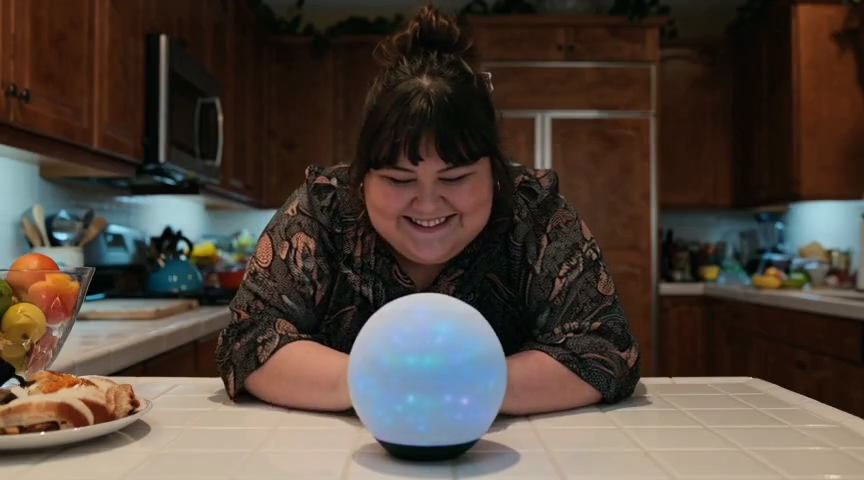
If you want to make people stop scrolling and stare in mild discomfort, MiniMax H3 is currently the tool for the job.
It captures spoken dialogue with surprising accuracy. It does occasionally develop a hostage-taker’s grip on the conversation and refuse to stop rambling, but when it behaves, the delivery is spot on. You will pay for this with your time, as it is in no rush to finish rendering. The trade-off is the clarity of the output. It produces remarkably clean footage that is perfect for further refinement using reference images and specific frame inputs. We’ll save that technical deep dive for a future post.
Today is just about the viral appeal of things going horribly wrong.
I’ve been using H3 for a new tech-obsessive series, exploring exactly what happens when human anatomy and consumer hardware decide to merge. The resulting body horror mutations came out much better—and significantly weirder—than expected. It’s a very specific brand of surrealism, but it has added a thoroughly unsettling new layer to the site’s content.
Take a look below at what happens when flesh meets silicon:
The Dopamine Leviathan
What happens when the endless pursuit of notifications finally takes a physical toll. It turns out that chasing the next “like” eventually transforms you into a gigantic, pulsating mass of desperate validation.
The Infinite Panopticon
A VR doomscroller that has entirely forgotten what the real world looks like. Why bother taking the headset off when you can just fuse it directly to your optic nerves and scroll the void forever?
The Not-So-Smart Symbiote
The ultimate, inevitable evolution of the smart speaker. It started by just listening to your conversations, and now it has physically integrated with your nervous system. At least the audio quality is decent.
The Absolute Decibel Devourer
Active noise cancellation taken to its absolute biological extreme. For when you need to block out the outside world so completely that the ear cups permanently seal themselves to your skull.
Stock footage is a necessary evil. You either spend hours hunting for the exact clip of a specific action, or you compromise and use something just close enough that it physically hurts to look at. AI has thankfully changed that.
We are no longer just generating random, trippy fever dreams. Using tools like ComfyUI, Minimax H3, and LTX Video, we can hyper-speed concepts and build our own bespoke stock libraries. The real power here isn’t just saving the budget—it is the ability to generate hyper-specific, perfectly lit B-roll that actually matches your project’s aesthetic.
The secret is understanding which tool handles which job. If you need rapid, low-latency iteration to test a camera move or animation idea, LTX-2 excels at fast prototyping. If you need to lock in a specific character or product identity while dictating exact hand trajectories, Minimax H3 allows for explicit reference control—meaning you can tell it to preserve a jacket’s texture but completely ignore the original lighting. And if you need absolute granular control over the whole pipeline, tying in depth maps or edge control to keep things consistent, you build the workflow in ComfyUI.
Instead of writing vague prompts and hoping the AI reads your mind, you have to direct the model. That means breaking down prompts into strict formulas: defining the camera motion, separating the subject’s identity from the physical action, and describing movements as trajectories rather than just simple verbs.
I will cover LTX 2.5 Distilled in this post, and cover other models in my next posts to avoid this becoming too long of a post/heavy video content wise.
LTX 2.5 Distilled
Workflow & Technical Notes LTX 2.5 Distilled is insanely fast when compared to other current models being used on single GPU setups. Taking just shy of a few minutes to get a 720p and up to 20 seconds render. (4090 + 64GB ram)
The prompt: “Live-action imagery. The Vibe: ASMR calmness interrupted by impossible scale. The Scene: A photorealistic slice of Brighton pebble beach at dusk. The waves are rolling over the stones. A monolithic, gravity-defying gigantic, matte-black rubber duck suddenly breaches the water, causing a huge wave that spalshes towards the camera as the video ends. Audio: ASMR calmness suddenly interupted by giant rubber duck breaching water”
The prompt: “ASMR style video loop. Contrast classical architecture with brutalist tech, a gothic style interior with a sterile, glass-enclosed server rack directly in the center of the very large room. The video is composed to create a seamless loop with matching start and end states.”
The prompt: “ASMR style video loop. Contrast classical architecture with brutalist tech, a gothic style interior with a sterile, glass-enclosed server rack directly in the center of the very large room. The video is composed to create a seamless loop with matching start and end states.”
The prompt: “A eerie, ground-level ASMR shot from a static perspective, looking down a perfectly manicured but infinite suburban street at artificial twilight. The highly detailed houses are real except that every front door is pencil-thin and unusable. Above each door is only one window: a continuous, weirdly long horizontal slit. The environment recedes into a recursive loop.”
If your goal is to create a seamless, static camera loop—such as a cozy lo-fi background, a subtle cinemagraph, or a calm landscape where only the trees move—LTX will usually fail. As you can see from the examples above. While we still got great content, it failed to make it loop or remain static.
The “Forward Motion” Bias
Because LTX is trained to prioritize momentum and high-action generation, it struggles to comprehend absolute stillness. When you prompt it for a static shot, the model tends to do one of two things:
Ignore the prompt: It will inject unwanted camera drift, slowly zooming or panning anyway.
Artifacting: If forced to keep the camera completely still, the generation often degrades, introducing strange warping or morphing artifacts as it tries to resolve its internal urge to create motion.